
How does oak wilt move from one oak to the next?
Two ways, according to the Texas A&M Forest Service (Feb 5, 2024 article; checked Nov 14, 2026). Underground, the fungus travels through interconnected root systems from tree to tree, so neighboring oaks can share it. Above ground, sap beetles carry spores to fresh wounds, which is why the season and the paint matter. The Forest Service also says not to move firewood.
The Forest Service counts 76 Texas counties with confirmed oak wilt (checked Nov 14, 2026), much of it across Central Texas and the San Antonio area. The Forest Service's county maps are the place to check the current list for Guadalupe County.
What does oak wilt look like on a live oak?
Live oaks have what the Forest Service calls intermediate susceptibility. The sign it describes in infected trees is in the leaves: yellow and brown veins, known as veinal necrosis. Red oaks, including Texas red oak, are hit harder and can die in as little as one month after infection.
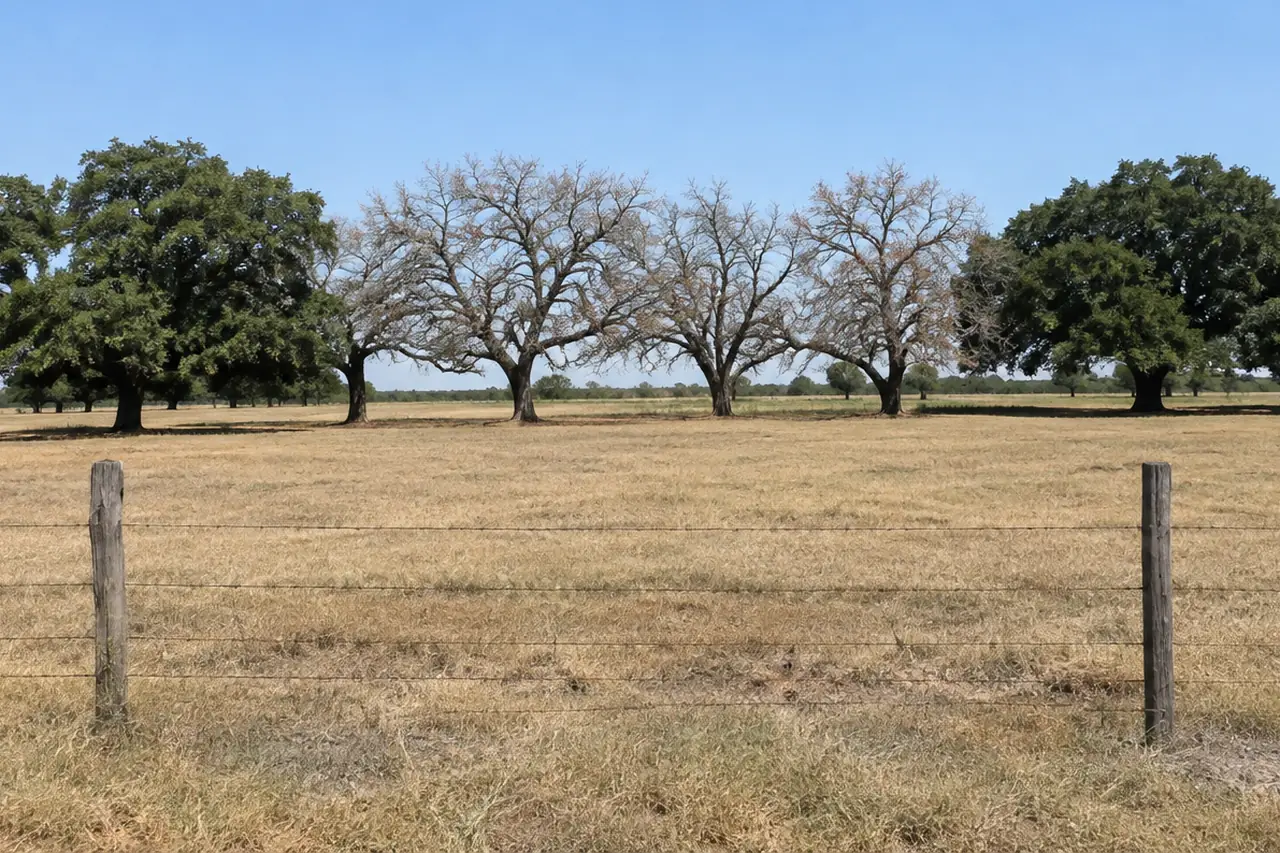
A thin or bare crown by itself doesn't name the cause. Drought, hypoxylon canker and storm damage can also leave a live oak looking sparse, which is why the leaf veins are the clue to look for.
When should a live oak in Seguin be pruned?
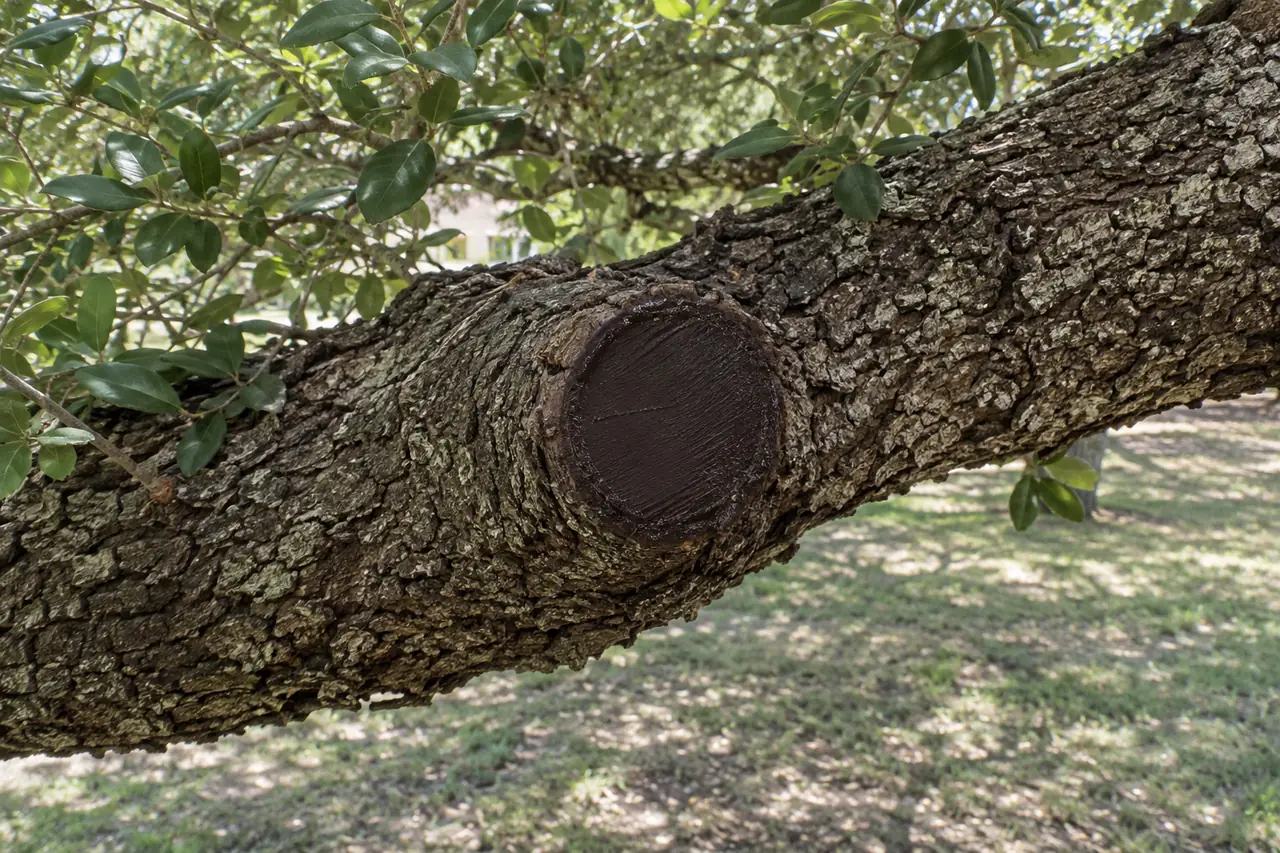
Between July and January. The Forest Service guidance is to avoid pruning or wounding oaks from February through June, and to paint all oak wounds immediately, whatever the season (checked Nov 14, 2026). That second part is easy to forget: a winter cut gets painted too.
- Routine work. Lifting limbs off a roof, clearing the driveway, taking out dead wood: schedule it for July through January.
- Storm breaks in spring. A limb that tears off in April can't wait for July. Have the broken stub cut clean and painted right away.
- Ask about paint. Before the work starts, confirm that every oak cut will be painted the same day.
Is there help paying for oak wilt work?
Yes, through the Texas A&M Forest Service oak wilt cost-share program, whose caps the Forest Service raised in February 2026 (program page checked Nov 14, 2026):
- trenching to break root connections: up to 50 percent of approved costs, capped at $5,000 per cooperator per year;
- tree pushing, also called roguing: up to 50 percent and $5,000;
- removing diseased red oaks: up to 50 percent and $2,000;
- projects shared by several cooperators: up to 50 percent and $7,500 per project per year.
The catch: an application must be approved before any cost-shareable treatment begins. The program's contact number is (979) 458-6600 (checked Nov 14, 2026).
What is hypoxylon canker, and is it dangerous?
Hypoxylon canker shows up as a dead lesion on limbs, branches and trunks, and it can affect any type of oak, live oak and Texas red oak included. Texas A&M AgriLife Extension says it can quickly colonize trees already weakened or stressed by heat, drought, ice storms or hail damage, and that it compromises a tree's structural integrity, making it "a danger to life and property" (Plant Clinic fact sheet, May 22, 2009; checked Nov 14, 2026).
A live oak with large patches of dead bark on the trunk or main limbs, especially after a dry summer, deserves a closer look before the next windstorm.
How hard has drought been on Texas oaks?
The Texas A&M Forest Service estimated that the 2011 drought killed 301 million trees on Texas forest land, plus another 5.6 million in urban areas (Sept 25, 2012 release; checked Nov 14, 2026). The USDA Forest Service's 2025 Forest Health Highlights for Texas reported severe drought over fiscal 2025 that "resulted in widespread decline and mortality of multiple tree species" (checked Nov 14, 2026). Drought stress is also one of the conditions AgriLife lists as opening the door to hypoxylon canker.
When should a live oak come down?
When it's dead, when its trunk or main limbs have lost their strength to canker or decay, or when a storm has split it so it leans toward the house, the street or a line. Live oak is on Seguin's preferred tree list, so a live oak 6 inches or more across at 4.5 feet counts as protected on land the code covers. Two rules often settle it for a home: platted single-family lots are exempt from the city's permit (UDC Sec. 5.2.8.B.5), and state law §212.905(h) generally bars Texas cities from forbidding removal of a dead, diseased or imminently dangerous tree, with an exception for property within five miles of a federal military base in active use as of Dec 1, 2017 (checked Nov 14, 2026). Details are on the Seguin tree permit page and the tree removal page.
If the tree had oak wilt, keep its wood on the property; the Forest Service advises against moving oak firewood.
Live oak questions from Seguin yards
Do oak cuts really need paint?
For oaks in Texas, yes. The Forest Service says all oak wounds should be painted immediately, no matter the time of year (checked Nov 14, 2026).
My neighbor's live oak is dying. Should I worry about mine?
Oak wilt can travel between oaks through connected roots, so a neighbor's sick oak is a reason to watch your own leaves and to call the Forest Service's oak wilt program about trenching and cost shares.
Who can do the pruning?
Send a request or call (830) 406-4266. The request reaches one independent tree contractor in the Seguin area; mention that the tree is a live oak so the timing and paint come up from the start. See also tree trimming.
Sources: Texas A&M Forest Service on oak wilt (Feb 5, 2024), the oak wilt cost-share program page and its February 2026 funding increase and the 2011 drought (Sept 25, 2012); Texas A&M AgriLife Extension Plant Clinic, hypoxylon canker; USDA Forest Service, Texas Forest Health Highlights 2025; City of Seguin plant lists; Seguin Unified Development Code; Texas Local Government Code §212.905. All checked Nov 14, 2026.